
The New Space Race: Why Now?
- bespoke62
- 3 days ago
- 6 min read
If you have read the financial press, you will have noticed that space is suddenly everywhere. The reason comes down to one number: the cost of reaching orbit has fallen by more than 95% since 2011. That collapse is why venture capitalists have poured more than $200 billion into space and defence startups since 2020, and why SpaceX's June 2026 listing on the Nasdaq became the largest IPO in history.
Humans have been launching rockets since the 1950s, and satellites are hardly new. What changed is the price of getting there, and that is where we start.

The cost of a kilogram
For most of the space age, the biggest obstacle to doing anything in orbit was not technology. It was the price of traveling to space.
During the Space Shuttle era, NASA estimated it cost roughly $54,500 to put a single kilogram into low Earth orbit. To put that in perspective, a typical communications satellite of that period weighed around 3,000 kilograms, so the launch alone cost in the region of $160 million, before the satellite itself had even been built. At that price, space was reserved for governments and a handful of telecoms operators flying enormous satellites designed to last decades, because replacing them was unthinkable.
Then SpaceX worked out how to land and reuse its rockets. A rocket is the only vehicle humanity has ever used once and then discarded. Imagine the cost of flying if every aircraft were scrapped after a single flight. Reusability changed the arithmetic completely. SpaceX's Falcon 9 brought the cost down to roughly $2,700 per kilogram, while Starship, its next-generation vehicle still in testing, is targeting less than $200 per kilogram.
That confirms the number we opened with: a realised reduction of more than 95% since the Space Shuttle programme ended in 2011, with Starship's target pushing that beyond 99% once proven at scale. When the price of a foundational input falls that far, entirely new industries become viable that were previously impossible.
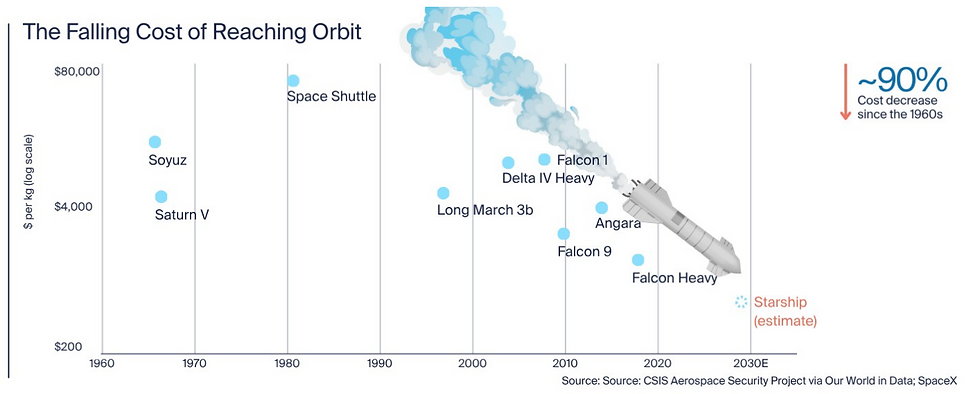
Launch cost per kilogram to low Earth orbit. Historical launch systems are shown using achieved costs; Starship is shown separately as a projected target cost.
What cheap access unlocks
The clearest proof is Starlink, SpaceX's satellite internet service. In 2020 it had around 1,000 satellites in orbit and no customers. As of mid-2026 it operates more than 10,000 satellites and serves over 10 million subscribers across 164 countries. A business of that scale was simply not possible at old launch prices. Instead of a few enormous satellites which didn't have the luxury of failing, Starlink flies thousands of cheap ones that are routinely replaced and upgraded, much like servers in a data centre.
Telecoms is just the first industry being rebuilt this way. As costs keep falling, more applications become viable. Earth observation satellites can monitor crops, shipping, insurance risk and climate. Missile warning and other defence systems benefit too. So does manufacturing in orbit. Further out, ideas like space-based solar power and orbital data centres could follow. Some of these will disappoint. But McKinsey estimates the space economy could grow from around $630 billion in 2023 to $1.8 trillion a year by 2035.
We have seen this movie before
If this pattern sounds familiar, it should. It is how every major technology platform of the past fifty years developed: PCs, the internet, mobile, cloud computing and now AI. First comes the infrastructure build-out. Then capability improves and costs fall. Only later do the applications and business models arrive, usually ones nobody predicted. Space is currently in phase one, the infrastructure phase. Tellingly, some of the professional investors we speak with who own SpaceX say their valuation models stop at Starlink and launch. Activities beyond that, from in-orbit manufacturing to lunar logistics, are treated as optional upside rather than forecast cash flows.
The catch: much of this rests on one rocket
It is worth being clear-eyed about the thesis's weak point. The most transformative version of the thesis still depends on Starship. Many of the industry's most ambitious forecasts assume that the rocket works at scale. It does not yet.The rocket remains in testing, with several very public failures alongside its successes. Achieving reliable, rapid, fully reusable flights at its target price is a problem nobody has solved before. The projected portion of the chart above is exactly that: a projection.
If Starship is delayed by years, or never reaches its target economics, the picture changes materially. Falcon 9 costs are established and already support profitable telecoms and observation businesses, so the industry would not collapse. But the more speculative industries only work at the lower price point and would stay on the drawing board. Any valuation that assumes the cheaper future arrives on schedule would deflate sharply.
There is also unusual concentration risk. One company, SpaceX, accounts for the large majority of global launch capacity and sets the pace of cost reduction for the entire industry. Although now listed, it remains controlled by a single individual with more than 80% of the voting power. This matters because concentrated control means fewer of the usual checks that come with public ownership, and unusually high dependence on one person's judgement and continued involvement.
None of this is unique to SpaceX. Several large listed companies have similar structures, but it is worth understanding rather than assuming a stock exchange listing means business as usual. Competitors are developing their own reusable rockets, but for now, a trillion-dollar industry rests to a remarkable degree on one company's execution.
What about China?
It is the question that comes up in almost every space conversation, and fairly so. China is the clear number two: its state programme launches more rockets than any country bar the United States; it is building two networks of thousands of satellites similar to Starlink, and a wave of well-funded Chinese startups is racing to crack reusable rockets. None has yet matched SpaceX on reusability or launch cadence, but the gap is measured in years, not decades.
For investors, China matters in two ways. It confirms the industry is strategic: both superpowers now treat orbit as critical infrastructure, which underwrites government demand for decades. But Chinese space assets are largely closed to foreign investors. So China's real significance is as a competitive spur that will keep Western space and defence spending elevated, rather than as an investable market in itself.
Where this leaves an investor
Here we need to be honest about the practicalities, because they matter more than the excitement.
First, you may already have some SpaceX exposure in your portfolio. Its June listing on the Nasdaq valued the company near $1.8 trillion, and within weeks the stock was added to other major share indices. Anyone holding a global index fund, and many actively managed global funds, now owns a slice.
Second, understand what the price assumes. One global growth manager we engage with, an early SpaceX investor, deliberately avoids valuing it against other space stocks. Instead, the manager benchmarks it against the world's great industrial monopolies, businesses like chipmaker TSMC and ASML, which sit at the centre of the global semiconductor industry.
Space is now being valued as infrastructure rather than science fiction. But even on that flattering yardstick, SpaceX's listing price, roughly three times the five largest US defence contractors combined, only makes sense if the company grows rapidly and earns exceptional profit margins for well over a decade. There is a genuine fundamental case; it simply requires nearly everything to go right.
Third, beyond SpaceX the listed universe is thin and often speculative. A handful of companies, such as Rocket Lab, are generating real revenue, but many are pre-profit, and some have rallied largely in the hope that a listed SpaceX would pull their valuations up with it. That is momentum, not fundamentals. In every infrastructure boom, from railways to dot-coms, most early specialist companies did not survive even when the trend proved correct. That is why we prefer to participate through experienced global managers. They can size positions responsibly within diversified portfolios, rather than through concentrated bets on a theme still in its earliest stages.
Watching the right signal
The point of this article is not that you should rush out and buy space stocks; if you hold a diversified global portfolio, you already own some. The point is to understand both why a theme is real (a 95% collapse in the cost of reaching orbit) and where it could break (a future price point that depends on one unproven rocket and one company). That is what allows an investor to engage with it calmly.
Space may well become one of the defining themes of the coming decades, and along the way it will produce failed rockets, overhyped valuations and painful drawdowns. The investors who do well will let the industrial reality, rather than the headlines, set the pace. As always: diversification, patience and healthy scepticism toward anyone promising you the moon.
[1] The Space Shuttle programme ran from 1981 to 2011 and was NASA's primary means of reaching orbit for three decades.
[2] Falcon 9 is SpaceX's workhorse rocket, in service since 2010. Its first stage, the most expensive part, lands itself after launch and is refurbished for reuse, sometimes within days.
[3] Starship is SpaceX's next-generation rocket, currently in flight testing. Designed to be fully and rapidly reusable, it is intended to eventually carry over 100 tonnes to orbit.
[4] World Economic Forum and McKinsey & Company, "Space: The $1.8 Trillion Opportunity for Global Economic Growth," April 2024
[5] The two programmes, known as Guowang and Qianfan, have around 350 satellites in orbit combined as of mid-2026, but plan for over 28,000 between them once fully deployed.


Comments