
March 2026 Newsletter
- bespoke62
- Mar 9
- 5 min read




Watch

The optimism bias. A neuroscientist explains why 80% of us are hardwired to expect things will turn out better than they do, and why that’s mostly a very good thing.
Listen
The Most Overrated Form of Capital [5 minutes].
Money is the loudest form of capital you have, but probably the least interesting.
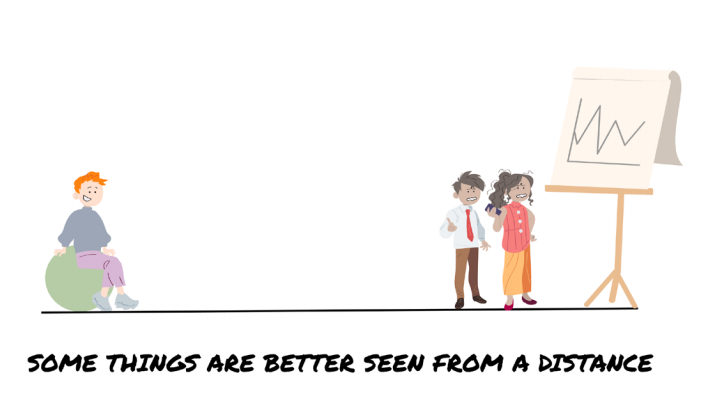
Standing at a Distance
In 1881, a strange piece of advice circulated among investors hoping to make sense of Wall Street. It wasn’t about which stocks to buy or when to sell them.
“To see and comprehend the market, you must always stand off at a distance.”
This strange, but simple, advice reasoned that the constant talk of nearby speculators would drive you into a “state of semi-insanity, where you in all probability will do something for which you will despise yourself the very next moment.”
It argued that the only antidote to the crowd’s temptations was to physically remove yourself to escape the noise.
This advice was printed close to 150 years ago, but it seems as relevant as ever. The temptations of that age (the physical trading floor, the stock tickers, etc) may be long gone, but it’s arguable that in the current age, we are plagued by even more noisy temptations.
While times have changed, the core problem remains, and it’s one that every investor needs to defeat through sensible tactics and the most valuable trait of all: discipline.
Why Closeness Leads to Bad Decisions
In most disciplines, the more time you devote to the craft, the more success you can expect. The piano is mastered by spending time at the keys. Golf is mastered by practising the basics. Business is won by those who best understand the market and its customers.
And so, in our roles as investors, when markets swing, we want to know why. It feels like the responsible thing to do.
Unfortunately, being close to information is not the same as knowing what to do with it. Research suggests that investors who check their portfolios frequently trade more often, react more sharply to losses, and generally perform worse over time than those who maintain a healthy distance.
While this may seem counterintuitive, we all know from personal experience the emotions we feel when experiencing financial loss. The human brain has not adapted well to the modern world of prosperity and long-term financial planning.
And so, when panic or euphoria spreads through the financial world and everyone around you is frightened, fear is rational, and caution seems like the perfect response.
The financially literate understand this trap and actively seek ways to distance themselves from the noise to focus on their long-term goals.
Creating Distance When Everything Is Instant
Standing at a distance once meant physically walking away, but in today’s connected world, it requires something more deliberate.
If you accept the truth that more activity often leads to worse results (which can often be understood from painful experience), then proactively making it harder to hear the noise is the responsible response.
For some investors, this means checking their portfolio quarterly rather than daily, deleting the app that shows market movements, or turning off the station that does daily market commentary.
Distance doesn’t have to be only physical. Psychological distance can help, too. When headlines turn negative, remind yourself of the actual timeframe that matters to your life. A thirty-year plan doesn’t require daily scorekeeping, and sensible investors have come to appreciate that the less frequently you measure results, the more clearly you see the trajectory that actually matters.
The Advantage of Calm
The 1881 advice concluded by recommending that investors act with patience, discipline, and thoughtful composure.
In an age where information is in no short supply, “knowing more” will never be an advantage. The only advantage of the literate investor is the ability to remain calm when others are frantic.
While market and world events will continue to bring surprises, we strongly believe that, in the long run, financial markets and the great companies of the world will continue to reward investors who can resist the urge to react to short-term noise.
Rather than adding to an already-noisy world, our role is to clearly understand your situation and goals and help you implement a strategy that lets you stand at a distance with confidence.
Read

The Three Real Causes of Retirement Anxiety [8 minutes]. A retired doctor identifies the three real sources of retirement anxiety.
10 Rules For Dealing With Uncertainty [5 minutes]. Ten reminders for staying steady when the world feels uncertain, ending with the most underrated investment decision of all: doing nothing.
You Can Invest. But How Much Can You Suffer? [12 minutes]. Examining the gap between what you think you can handle and what your nervous system actually tolerates.

What happens when you stop feeling needed? [8 minutes]. A thoughtful look at why middle age feels so unsettling, and what the research says about building a life where you still feel like you matter.
There Actually Is A Free Lunch [12 minutes]. The most valuable things in your career and life probably came from someone else’s generosity, and how to pass that on.
Rational Optimism
The media is not a friend of the disciplined and patient investor. Ignoring the key determinants of lifetime investor returns, the media focuses on short-term returns, market predictions, and negative news.
We present the following as an antidote to the onslaught of negative news:

AI Is Creating More Work, Countering the Doomers for Now
The fund giant Vanguard has released an intriguing analysis finding that both wage and job growth increased over the past two years in the occupations most exposed to AI.
Argentines Snap up Lego and Computers as Economy Opens
Argentines are scooping up Lego sets, Apple computers and Stanley thermoses from abroad, as libertarian president Javier Milei’s efforts to open the closed economy prompt a flood of foreign goods.

Number of Women with Financial Accounts Is Increasing
Women’s financial inclusion is experiencing a remarkable transformation. The Global Findex 2025 report finds that as of 2024, 73% of women in low- and middle-income economies(LMICs) have a financial account, a 7-percentage point increase from 2021.
Visuals
The Best Countries to Retire in the World, Ranked
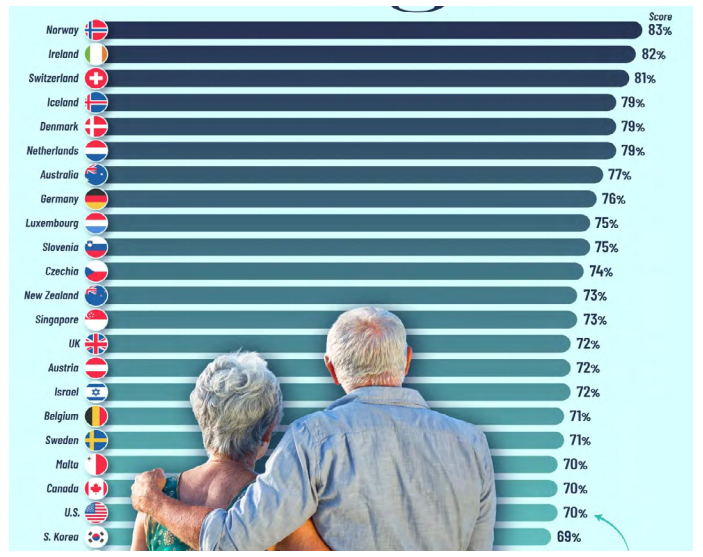
The 2025 Natixis Global Retirement Index ranks countries across four pillars: retirement finances, material wellbeing, health, and quality of life. This year’s results show Europe continuing to out-perform, while North America slips further down the table.
The World’s Richest Countries vs. the Happiest Countries

The world’s richest countries generate staggering income per person. But when it comes to life satisfaction, some of the wealthiest nations fall surprisingly short.
The Growth of $100 by Asset Class (1965–2025)
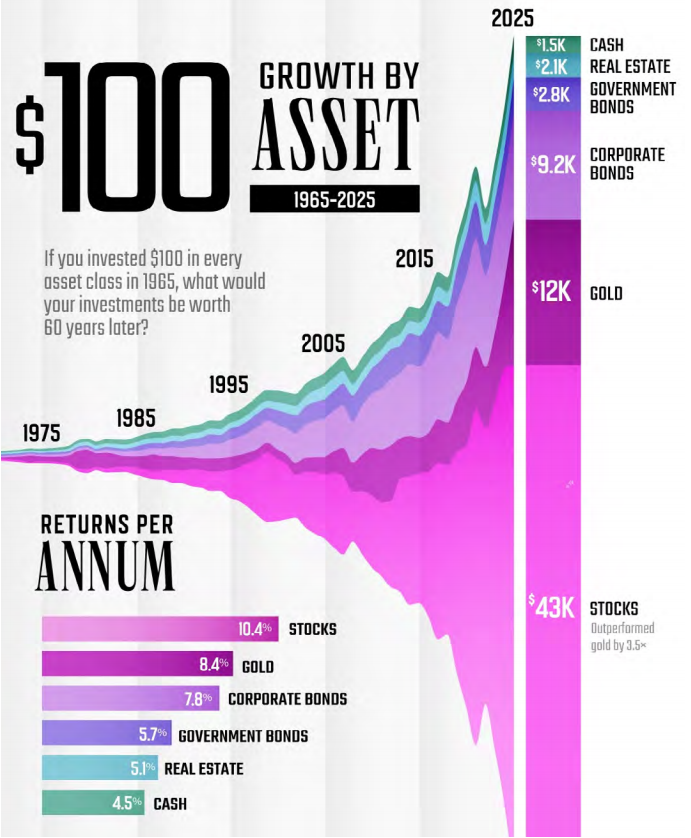
What would $100 invested in 1965 be worth today? For stocks, it would’ve multiplied 435 times, but other asset classes have significantly lower returns.
Here’s how each asset class performed over 60 years, based on data from NYU Stern professor Aswath Damodaran. Stocks reflect S&P 500 total returns with dividends reinvested, real estate follows the Case-Shiller Home Price Index (price only), and cash represents three-month U.S. Treasury bills.
The table shows the nominal (before inflation) returns of a $100 investment across six major asset classes between 1965 and 2025, with values representing the investment’s value at year-end.


Comments