
July 2026 Newsletter


2026 Midyear Review
The halfway mark of the year is a good place to stop and look back. Six months of news tends to blur together, and the point of a review is to separate what actually mattered from what only felt urgent at the time.
At the start of the year, we cautioned that after three strong years for global markets, a temporary market decline would not be unusual, that any setback would probably be set off by something few of us were discussing, and that the one risk worth watching was how heavily the market leaned on a small group of large technology companies to continue to grow their earnings.
What’s Happened
A small setback and decline did arrive, but not from the direction many expected.
The Straight of Hormuz
In late February, the United States and Israel launched military strikes against Iran. The Strait of Hormuz was closed, disrupting a large share of the world’s oil supply, and the price of oil doubled within weeks. Inflation, which had been easing, began to climb again, and markets fell and swung sharply through March and April. A conditional ceasefire and framework have since been reached, and oil has fallen to a level slightly higher than it was at the beginning of the year.
Market Returns & Inflation Concerns
We started the year expecting further interest rate cuts, but due to the conflict’s inflationary effects, the next interest rate change is now more likely to be upwards than downwards.
Although markets declined during the peak of uncertainty, they did not crash. By mid-2026, both the US and global markets have increased by approximately 9 percent. The specific value in your currency will vary based on exchange rate fluctuations during this time.
The reason for that resilience was not market sentiment but real corporate earnings. Through the first quarter, the world’s major companies extended a run of strong profits into a sixth straight quarter, and full-year estimates have since been revised upwards.
SpaceX IPO
The last notable event was the SpaceX initial public offering (IPO), the largest of all time. With a few other large private companies expected to list soon, the major market indices will soon include companies that have until now been available only to a select group of private investors.
What We’ve Learned
The first half of the year offered three lessons worth holding onto.
The trigger is rarely the one you are watching.
In January, the risk on most minds was the technology sector and the chance its spending would disappoint. The actual shock was a war. The risks everyone can see are mostly already reflected in prices, so the ones that move markets are the ones not being discussed. You cannot prepare for a surprise you have not imagined.

You can only build a plan that does not depend on knowing what comes next, with enough money set aside to cover near-term needs.
A frightening half-year can still be a profitable one.
It would have been easy in March to sell and step aside until things calmed down. Anyone who did would have locked in losses near the low and missed the recovery. The tariff scare of April 2025 taught the same lesson. The discomfort of staying invested through a decline is real, but it’s the price of admission for long-term investors. Bad news and a rising portfolio sit together more often than most people expect.
The risk we named arrived, and a diversified portfolio absorbed it.
For two years, the common worry was the market’s reliance on a handful of giant technology companies, and the fear that if they stumbled, they would take the whole market down. In the first half of the year, these companies (often called the Magnificent Seven) underperformed the overall market. The risk was not resolved in the crash many investors feared, but in a rotation to the broader market. The rest of the market rose to meet the gap, once again proving why diversification matters.
Looking Ahead
The second half of the year will bring its own surprises, as every period does. Inflation has not fully settled, interest rates may rise rather than fall, and the peace in the Middle East is recent and untested.
There will be worries we are not yet naming, and at some point, there will be another decline. This is a normal, recurring part of investing rather than a sign that something has broken down.
Three good years did not entitle us to a fourth without interruption, and the first half delivered the kind of interruption we expected, even if the cause was one we did not expect.
As ever, it is a privilege to help you navigate these years. If you would like to discuss how recent developments affect your own financial life plan, please let us know.
Compliance disclaimers:
“The value of investments and any income from them can fall as well as rise. You may not get back the full amount invested. Past performance should be used as a guide only and is not a guarantee of future performance.”
“Different investors will view these trade-offs differently depending on their objectives, time horizon, and attitude to risk. If you would like to discuss how this relates to your own circumstances, please speak to us”.
Read

The Dangerous Allure of “Dying with Zero”
[5 minutes]. A hospice doctor’s counterweight to “die with zero.”
A Sunday Thought About Money
[2 minutes]. What all the saving is really for.
Why Your Financial Plan Is Already Wrong
[3 minutes]. Why your plan was wrong from day one, and why that’s fine.
Anniversaries [1 minute].
Why an anniversary is a decision, not a date.
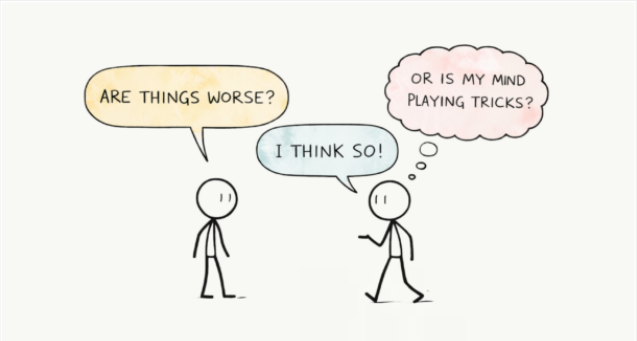
Is Life Worse Today Compared to 10 Years Ago?
[6 minutes]. Three biases that make the present feel worse.
Behavioural Lessons From the World Cup
[2 minutes]. The biases that trip up investors, spotted on the pitch.
Rational Optimism
The media is not a friend of the disciplined and patient investor. Ignoring the key determinants of lifetime investor returns, the media focuses on short-term returns, market predictions, and negative news.
We present the following as an antidote to the onslaught of negative news:

Data Show Freeing Economies Doesn’t Harm the Environment
For many, economic growth and environmental protection exist in direct tension. People with this belief generate policy proposals to permit growth while protecting the environment.
The Western World’s First Grid-Scale Small Modular Reactor
The small modular reactor has been the nuclear industry’s favorite slide for about a decade. Utilities pitch it, governments model it, conference panels argue about it, and for years that was as far as it got in the Western world.

A Growing African Middle Class Is Increasingly Mobile
The number of tourists visiting African countries grew by almost 8 percent last year — the fastest growth in the world, according to the United Nations World Tourism Organization. This surge isn’t being driven only by visitors from Europe or Asia.
Visuals
How the World Added Decades to Life Expectancy
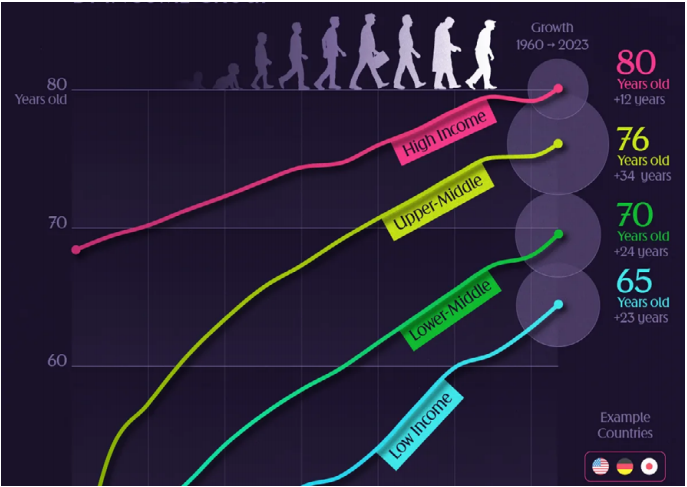
The average person today can expect to live far longer than someone born in 1960, regardless of where they live. This chart tracks life expectancy at birth across four World Bank income groups. While high-income countries still have the longest lifespans, the biggest gains have come elsewhere.
The Biggest IPOs in History — and Where SpaceX Fits In

The Elon Musk-founded company is expected to raise roughly $75 billion when it goes public on June 12, 2026, which would make it by far the largest IPO ever recorded. For comparison, the current record holder, Saudi Aramco, raised $25.6 billion in its 2019 debut.
The World’s Biggest Companies by Region

The world’s corporate landscape has become increasingly concentrated in a handful of U.S. mega-cap companies. This visualization ranks the 10 largest publicly traded companies across the Americas, Europe, Asia-Pacific, and the Middle East using market capitalization data from CompaniesMarketCap as of June 2026.
The scale of America’s largest firms is difficult to overstate. NVIDIA alone is worth $5.4 trillion, exceeding the combined value of Europe’s 10 largest companies. Together, the top 10 companies in the Americas are worth $28.1 trillion, more than the combined value of the top 10 companies in Europe, Asia-Pacific, and the Middle East.


Comments